The Main Goals of Generative AI: 7 Objectives Transforming Innovation in 2026

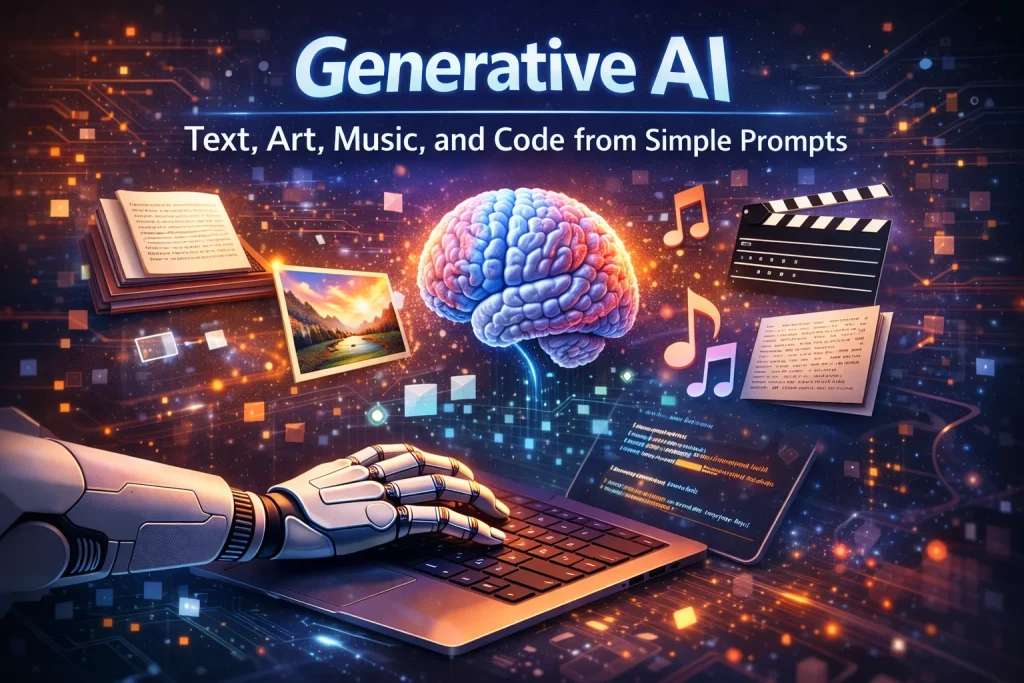
Generative AI has emerged as one of the most transformative technologies of our time, fundamentally changing how we create content, solve complex problems, and approach innovation. Unlike traditional AI systems that analyze existing data to make predictions or classifications, generative AI creates entirely new content—from text and images to music, video, code, and even scientific hypotheses. According to McKinsey’s State of AI report, generative AI could add between $2.6 trillion to $4.4 trillion annually to the global economy, with the technology already being adopted by 65% of organizations as of 2024.
But what exactly is the main goal of generative AI, and why does it matter for businesses, creators, and society at large? This comprehensive guide explores the core objectives, real-world applications, and transformative potential of generative AI technology. For more insights on emerging AI technologies, check out our latest AI innovations.
What Is Generative AI and How Does It Work?
Generative AI refers to artificial intelligence systems that can create new, original content by learning patterns from massive datasets. These systems use advanced machine learning architectures—primarily deep learning models like Generative Adversarial Networks (GANs), Variational Autoencoders (VAEs), and transformer-based models such as GPT-4, Claude, and DALL-E 3.
The technology works by training on billions of examples, identifying underlying patterns and relationships, then using that knowledge to generate novel outputs that didn’t exist before. When you ask ChatGPT to write a poem or request Midjourney to create an image of “a futuristic city at sunset,” you’re witnessing generative AI in action—creating unique content based on learned patterns rather than simply retrieving stored information. Learn more about how to leverage these tools in our AI tutorials section.
The 7 Core Objectives of Generative AI
1. Content Creation at Scale
The primary goal of generative AI is to produce high-quality, original content across multiple formats quickly and efficiently. This includes:
- Text generation: Marketing copy, blog posts, product descriptions, email campaigns, and technical documentation. Tools like GPT-4 and Claude can generate human-quality writing that requires minimal editing. Discover the best AI writing tools available today.
- Image creation: DALL-E 3, Midjourney, and Stable Diffusion can produce professional-quality images, illustrations, and designs from text descriptions in seconds. Adobe reports that their Firefly AI has generated over 3 billion images since launch.
- Video production: Tools like Runway and Synthesia create video content including animated characters, product demonstrations, and personalized video messages without traditional filming.
- Audio and music: ElevenLabs generates realistic voice synthesis, while platforms like Suno and Udio compose original music in various styles and genres.
- Code generation: GitHub Copilot and Amazon CodeWhisperer write functional code across dozens of programming languages, with studies showing developers complete tasks 55% faster when using AI assistants.
Real-world example: Coca-Cola used generative AI (DALL-E and GPT-4) to create personalized digital artwork for their “Create Real Magic” campaign, generating over 120,000 unique submissions from consumers worldwide.
2. Augmenting and Amplifying Human Creativity
Rather than replacing human creators, generative AI serves as an intelligent collaborator that enhances creative capabilities. It handles time-consuming preliminary work—brainstorming ideas, creating first drafts, generating variations, and handling technical execution—allowing humans to focus on strategic direction, emotional resonance, and creative refinement.
Designers use AI to rapidly prototype dozens of logo concepts before selecting and refining the best options. Writers overcome blank-page syndrome by having AI generate outlines or opening paragraphs. Architects explore building designs that might never have occurred to them through traditional methods.
Real-world example: The fashion brand Stitch Fix uses generative AI to create original clothing designs by analyzing customer preferences and fashion trends, then having human designers refine and perfect the AI-generated concepts. This hybrid approach has led to some of their best-selling items.
3. Intelligent Automation and Efficiency
Generative AI dramatically reduces the time and cost associated with content production and repetitive cognitive tasks. What once took hours or days can now happen in minutes, enabling businesses to scale operations without proportionally scaling headcount.
Customer service departments use AI to generate personalized email responses. Marketing teams produce A/B test variations automatically. Software companies generate comprehensive documentation from code repositories. Legal teams draft initial contract versions based on templates and requirements.
Measurable impact: A Stanford and MIT study found that customer support agents using generative AI resolved 14% more issues per hour and reduced resolution time by 13.8%, with the largest productivity gains (35%) among novice workers. Stay updated with the latest efficiency improvements in our AI news section.
4. Driving Innovation and Discovery
By exploring vast solution spaces and generating novel combinations, generative AI accelerates innovation across industries. The technology identifies patterns humans might miss, suggests unexpected connections, and rapidly tests thousands of variations to optimize outcomes.
In pharmaceutical research, generative AI designs new molecular structures for drug candidates, potentially reducing drug development timelines from 10-15 years to 3-5 years. In materials science, AI generates new material compositions with specific properties. In business strategy, AI explores market scenarios and strategic options that human analysts might not consider.
Real-world example: Insilico Medicine used generative AI to discover and develop a novel drug candidate for idiopathic pulmonary fibrosis in just 18 months, compared to the typical 4-5 years for traditional methods. The drug entered Phase II clinical trials in 2023.
5. Synthetic Data Generation
Generative AI creates realistic synthetic datasets that mirror real-world data distributions without compromising privacy or requiring expensive data collection. This is crucial when real data is scarce, sensitive (like medical records), imbalanced, or costly to obtain.
Financial institutions generate synthetic transaction data to train fraud detection models without exposing customer information. Healthcare researchers create synthetic patient data for algorithm development while maintaining HIPAA compliance. Autonomous vehicle companies simulate millions of driving scenarios to train self-driving systems safely.
Real-world example: The Mayo Clinic uses generative AI to create synthetic medical imaging data, enabling them to train diagnostic AI models on rare conditions where real patient data is limited, improving detection accuracy for diseases affecting small patient populations.
6. Personalization at Scale
Generative AI enables true one-to-one personalization by creating unique content tailored to individual preferences, behaviors, and contexts. Rather than segmenting audiences into broad groups, AI generates customized experiences for each user.
E-commerce platforms generate personalized product descriptions emphasizing features relevant to each shopper. Educational technology creates customized learning materials adapted to individual student needs and learning styles. Marketing platforms generate personalized email content, subject lines, and send times optimized for each recipient.
Real-world example: Spotify uses generative AI to create personalized playlist cover art and descriptions for each user’s Discover Weekly and Daily Mix playlists, generating millions of unique, contextually relevant visuals every week.
7. Accessibility and Democratization
By lowering barriers to creation, generative AI democratizes capabilities once requiring specialized training, expensive tools, or large teams. Someone without coding experience can build functional applications. Non-designers can create professional graphics. People without musical training can compose original scores.
This democratization extends professional capabilities to small businesses, independent creators, students, and underserved communities, leveling the playing field and enabling broader participation in creative and technical work. Explore opportunities in the AI field through our AI jobs board.
Real-world example: The Be My Eyes app uses GPT-4 Vision to provide visual assistance to blind and low-vision users, describing images, reading text, and providing contextual information about their surroundings—effectively democratizing visual information access.
Industries Being Transformed by Generative AI
Marketing and Advertising
Brands generate unlimited ad variations, personalized campaign content, and dynamic creative optimization. Heinz used DALL-E to generate “AI ketchup” images, discovering the AI consistently created images resembling their iconic bottle—a powerful brand awareness campaign demonstrating AI’s recognition of their brand equity. Learn about marketing applications in our AI blog.
Healthcare and Life Sciences
Beyond drug discovery, generative AI creates personalized treatment plans, generates synthetic patient data for research, and produces medical imaging for training diagnostic systems. The technology is accelerating precision medicine by analyzing patient genetics, medical history, and current research to suggest optimal treatment protocols.
Software Development
Developers use AI to generate boilerplate code, debug issues, write tests, create documentation, and even architect entire applications. GitHub reports that developers accept AI code suggestions 30-40% of the time, dramatically accelerating development cycles.
Education and Training
Educational institutions generate personalized learning materials, adaptive assessments, and interactive simulations. Khan Academy’s Khanmigo uses GPT-4 to provide personalized tutoring, adapting explanations to individual student comprehension levels and learning styles.
Architecture and Design
Architects generate building designs optimized for sustainability, cost, and aesthetics. Interior designers create room layouts and decoration schemes instantly. Product designers iterate through hundreds of form factors to find optimal solutions.
The Future: Where Is Generative AI Heading?
The trajectory of generative AI points toward increasingly sophisticated, multimodal systems that seamlessly integrate text, image, audio, video, and code generation. We’re moving from tools that generate individual content pieces to AI systems that orchestrate entire creative workflows and business processes.
Emerging capabilities include:
- Agentic AI systems that autonomously plan and execute complex multi-step tasks
- Real-time generation for live video creation and interactive experiences
- Scientific AI making genuine discoveries in mathematics, physics, and biology
- Personalized AI models trained on individual preferences and work styles
- Physical world applications in robotics and manufacturing
Gartner predicts that by 2026, over 80% of enterprises will have used generative AI APIs or deployed generative AI-enabled applications, up from less than 5% in 2023.
Key Takeaways: Why Generative AI Matters
The ultimate goal of generative AI extends beyond simply creating content—it’s about augmenting human potential, accelerating innovation, and solving problems previously beyond our reach. By automating routine creative tasks, the technology frees humans to focus on strategic thinking, emotional intelligence, and uniquely human contributions that AI cannot replicate.
Generative AI represents a fundamental shift in how we approach creation, work, and problem-solving. Organizations and individuals who learn to collaborate effectively with these systems will have significant competitive advantages, while those who ignore the technology risk falling behind.
The question is no longer whether to adopt generative AI, but how to integrate it thoughtfully and effectively into your workflows, creative processes, and business strategies. The future belongs to those who view AI not as a replacement for human creativity, but as a powerful amplifier of human potential.
Ready to dive deeper into the world of AI? Explore our comprehensive AI tools directory, stay updated with the newest AI releases, or learn how to maximize AI potential through our step-by-step tutorials.
Frequently Asked Questions About Generative AI
What is the main difference between generative AI and traditional AI?
Traditional AI analyzes existing data to make predictions or classifications, while generative AI creates entirely new content—text, images, code, music, and more—based on learned patterns from training data.
Is generative AI going to replace human workers?
Rather than replacing humans, generative AI augments human capabilities by automating repetitive tasks and enabling people to focus on strategic, creative, and high-value work that requires human judgment and emotional intelligence.
What are the best generative AI tools available in 2026?
Leading tools include ChatGPT and Claude for text, DALL-E 3 and Midjourney for images, GitHub Copilot for code, ElevenLabs for voice, and Runway for video. Check our AI tools section for comprehensive reviews.
How can businesses start implementing generative AI?
Start by identifying repetitive content creation tasks, experiment with accessible tools like ChatGPT or Claude, train your team on AI best practices, and gradually integrate AI into existing workflows. Read our implementation guides for detailed steps.
What are your experiences with generative AI? Are you using these tools in your work or creative projects? Share your thoughts in the comments below, and don’t forget to explore our latest AI articles for more insights.
Want to stay ahead of the AI curve? Subscribe to our newsletter or check out our daily AI news updates for the latest developments in artificial intelligence.